
Garages, lanais, pool decks and shops in Volusia County
Epoxy Flooring in Daytona Beach, FL
Resin floor systems chosen for Florida sun, summer humidity and sandy coastal living, installed over ground and repaired concrete.
- Free on-site estimates with a slab moisture test
- UV-stable topcoats on any floor the sun reaches
- Written, itemized price before any work starts
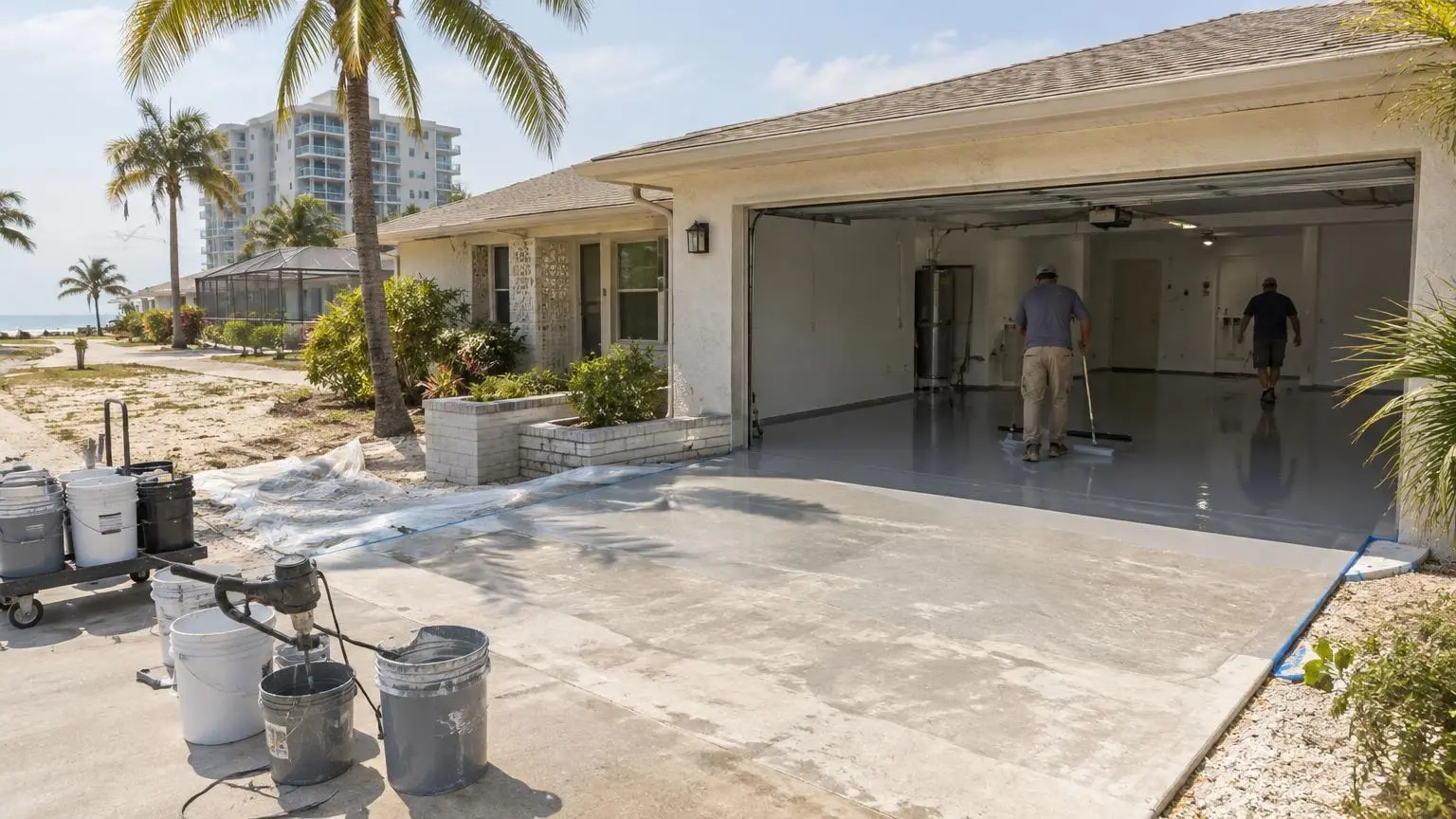
Concrete Coatings for the Halifax Coast
Epoxy flooring in Daytona Beach has to handle heat, sun and wet air far more than cold. Wikipedia classifies the city's climate as humid subtropical. Daytona Beach averages about 51 inches of rain a year, most of it from June through September, and freezes on only about three nights a year. A garage floor here rarely sees ice. It sees afternoon downpours, sticky air, sand carried in from the beach and hot tires rolling in after a summer drive. We build every floor around those conditions.
Sunlight is the first thing we plan for
HomeGuide rates the UV resistance of standard epoxy as poor to fair and polyaspartic as excellent. That gap matters in a city where garage doors stay open on sunny afternoons and lanais and pool decks sit in full sun all day. Plain epoxy exposed to sunlight can yellow and chalk over time. On any surface the sun reaches, we use a UV-stable polyaspartic topcoat over the base coat, or a polyaspartic system from the first coat. Outdoor coatings get lighter colors and a textured finish, because dark, smooth surfaces get hot underfoot and slick when wet.
Humidity, storms and timing
Florida's rainy season runs from May through October, and the state records more thunderstorms than any other. Resin coatings are sensitive to moisture while they cure. When the air is humid and the slab is cooler than the air, water can condense on the surface. That leaves cloudy patches and weak bonds between coats. Before each coat we measure air temperature, relative humidity and the dew point against the slab temperature. In summer we often start early, close the garage while the coating sets, and plan outdoor work around the afternoon storm pattern. If the numbers are wrong, we wait.
What sits under the slab
Florida's state soil, Myakka, is a sandy soil of flatwoods and barrier islands. Under natural conditions its water table can rise to within 10 inches of the surface for one to five months of the year. Building lots are filled and graded, but a slab on sandy ground in a wet climate can still draw moisture up from below. That moisture is a leading cause of coatings that blister or lift. We test every slab before recommending a system, and we use a moisture-tolerant primer where the readings call for it.
Daytona Beach homes and their floors
Much of Daytona Beach was built in the 1970s and 1980s. American Community Survey figures summarized by Point2Homes put the city's median year built at 1981, with about 40% of homes built between 1970 and 1989. About 41% of homes are single-family detached houses, and close to half are in multifamily buildings. A 40-year-old slab often carries old paint, sealer, oil stains, settlement cracks and patches. Condo garages and shared parking areas usually need association approval before a coating goes down. We look at all of that before we write a price.
After a storm
Hurricanes are part of life on this coast. Wikipedia notes the city was severely damaged during the 2004 season. In 2022, Hurricanes Ian and Nicole left nearly 50 coastal condominiums, single-family homes and hotels in Volusia County collapsed or at risk from beach erosion. Garages that take water come out of a storm with silt, staining and sometimes a lifted coating. A sealed, seamless floor is much easier to hose out and dry. It will not keep water out of the garage, and we will not coat a slab with an active leak or a structural problem until that has been fixed.
Choosing a system
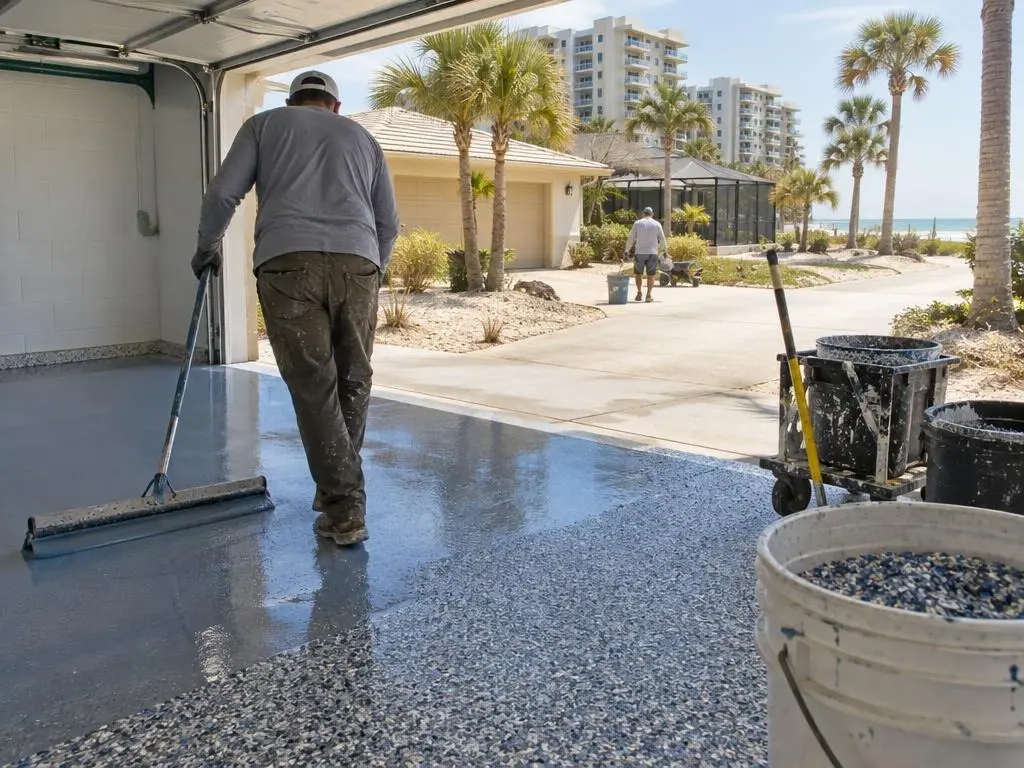
- Flake epoxy with a polyaspartic topcoat: the most common garage floor here. Colored chips hide sand and dust, add grip, and the topcoat handles sun through the open door.
- Full polyaspartic systems: fast curing, UV stable and usually back in service the next day. A strong choice for lanais and garages that get afternoon sun.
- Metallic epoxy: a poured, swirled finish for interior rooms, home bars, game rooms and shop showpieces where looks come first.
- Patio, lanai and pool deck coatings: textured, light-colored outdoor systems built for bare feet, pool water and full sun.
- Commercial and shop floors: thicker 100% solids systems for restaurants, hangars, auto and motorcycle shops, and warehouses.
What a typical garage job includes
- A walk-through to agree on what moves out and what stays
- A moisture test and a check for cracks, old coatings and low spots
- Diamond grinding of the whole floor and its edges, then dust removal
- Crack, chip and control joint repair
- Base coat, flake or color layer, and a UV-stable clear topcoat
- Written guidance on walk, return and parking times, plus how to clean the floor
What it costs
The related searches for epoxy flooring in Daytona Beach are mostly about price, so here is what published guides say. HomeGuide puts professionally installed epoxy at $4 to $10 per square foot, or about $1,600 to $5,800 for a two-car garage, and polyaspartic at $5 to $12 per square foot. Old coatings that must come off, crack repair and the finish you choose all move the total. We measure, test and then give you a written price. That written estimate is the price.
Our Epoxy Flooring Services
Six coating services for the concrete people around Daytona Beach actually live with: sunny garages, lanais and pool decks, interior slabs and busy commercial floors.
Garage Floor Coating
Flake or solid-color garage floors with a UV-stable topcoat, built for sand, hot tires and afternoon sun through the open door.
Learn more →Epoxy Flake Floors
Full-broadcast chip floors that hide sand and dust, add grip underfoot, and come in blends that suit coastal homes.
Learn more →Polyaspartic Floor Coating
Fast-curing, UV-stable coatings that let you walk on the floor the same day and park within a day or two.
Learn more →Patio & Pool Deck Coatings
Textured, light-colored coatings for lanais, patios and pool decks that see full sun, bare feet and pool water.
Learn more →Metallic Epoxy Floors
Poured, swirled metallic finishes for interior rooms, home bars, game rooms and garage showpieces.
Learn more →Commercial & Shop Floor Epoxy
Thick, chemical-resistant floor systems for restaurants, auto and motorcycle shops, hangars, warehouses and retail spaces.
Learn more →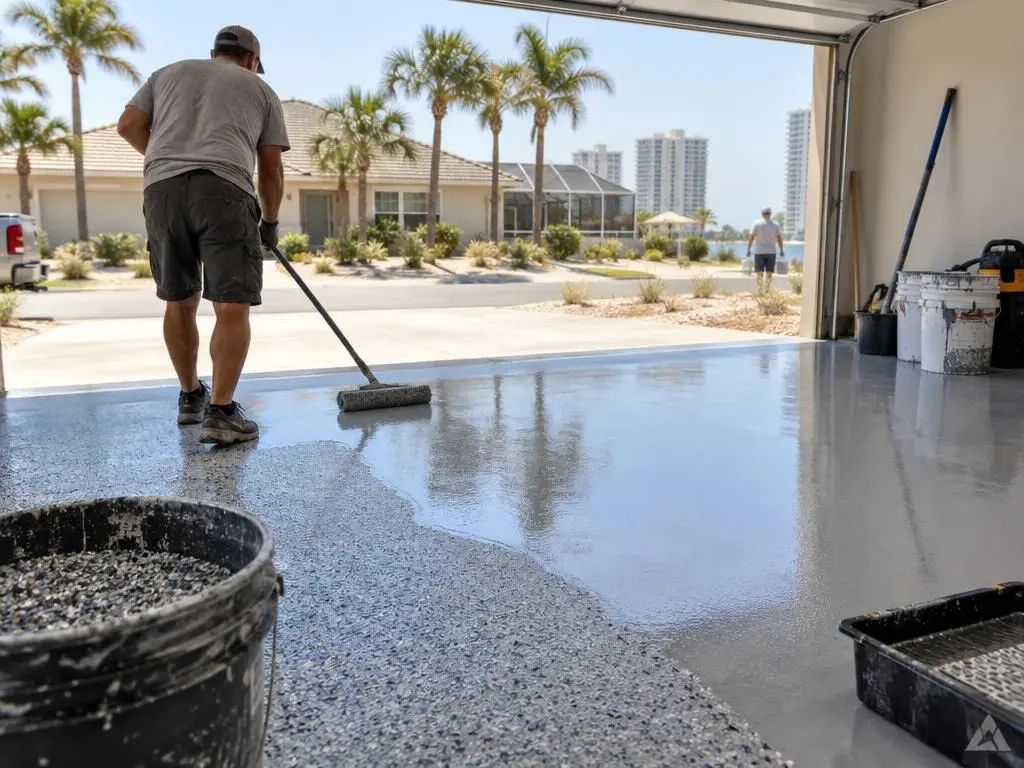
Why Homeowners Call Epoxy Flooring Daytona Beach
UV-stable finishes where the sun hits
Garage floors and outdoor surfaces get a polyaspartic topcoat or full polyaspartic system, because standard epoxy yellows in sunlight.
We measure the air before every coat
Temperature, humidity and dew point are checked against the slab. On a bad day we wait instead of trapping moisture under the coating.
Moisture tested before we quote
Slabs on sandy, wet ground can push moisture up. We test first and choose the primer to match.
One written price
Your quote lists the square footage, the prep, each coat and the total. Any change is written up for you to approve first.
Where We Work
Daytona Beach is the center of our service area. We also coat floors along the coast in Ormond Beach, Ormond-by-the-Sea, Holly Hill, South Daytona, Port Orange, Daytona Beach Shores, Ponce Inlet, New Smyrna Beach, Edgewater and Oak Hill, inland in Samsula-Spruce Creek, DeLand, Deltona, DeBary, Orange City, Lake Helen and DeLeon Springs, and north into Flagler County in Palm Coast, Flagler Beach and Bunnell. Conditions change across that area. Barrier island homes and condos take salt air, sand and storm surge, and many need association approval. Mainland neighborhoods from the 1970s and 1980s have older, often painted slabs. Newer planned communities inland and in Palm Coast tend to have larger attached garages with sound concrete that still needs proper grinding. Each area page covers what we know about homes and floors there.
- Epoxy Flooring in Daytona Beach, FL
- Epoxy Flooring in Ormond Beach, FL
- Epoxy Flooring in Ormond-by-the-Sea, FL
- Epoxy Flooring in Holly Hill, FL
- Epoxy Flooring in South Daytona, FL
- Epoxy Flooring in Port Orange, FL
- Epoxy Flooring in Daytona Beach Shores, FL
- Epoxy Flooring in Ponce Inlet, FL
- Epoxy Flooring in New Smyrna Beach, FL
- Epoxy Flooring in Edgewater, FL
- Epoxy Flooring in Oak Hill, FL
- Epoxy Flooring in Samsula-Spruce Creek, FL
- Epoxy Flooring in DeLand, FL
- Epoxy Flooring in Deltona, FL
- Epoxy Flooring in DeBary, FL
- Epoxy Flooring in Orange City, FL
- Epoxy Flooring in Lake Helen, FL
- Epoxy Flooring in DeLeon Springs, FL
- Epoxy Flooring in Palm Coast, FL
- Epoxy Flooring in Flagler Beach, FL
- Epoxy Flooring in Bunnell, FL
Common Questions
How much does epoxy flooring cost in Daytona Beach?
HomeGuide's national range for installed epoxy is $4 to $10 per square foot, or about $1,600 to $5,800 for a two-car garage. Polyaspartic runs about $5 to $12 per square foot. Removing an old coating, repairing cracks and adding flake or metallic finishes raise the total, so we price each floor after seeing it.
How much does it cost to epoxy a concrete floor of 500 square feet?
At HomeGuide's $4 to $10 per square foot, a 500 square foot floor works out to roughly $2,000 to $5,000 for epoxy. HomeGuide's polyaspartic table puts 500 square feet at $2,500 to $6,000. Heavy prep, such as grinding off paint or patching many cracks, can push a floor above those numbers.
What are the drawbacks of epoxy flooring?
Epoxy needs a dry, well-prepared slab and can peel if moisture or oil is trapped under it. HomeGuide notes standard epoxy can take up to a week to fully cure and rates its UV resistance as poor to fair, so in Florida sun it can yellow without a protective topcoat. A glossy finish can also be slippery when wet unless texture or flake is added. Each of these is handled with the right system and prep.
Which type of epoxy is used for flooring?
Floors are coated with water-based, solvent-based or 100% solids epoxy. HomeGuide lists water-based epoxy as lasting about 3 to 5 years and solid epoxy about 10 to 20 years. Professional garage and commercial floors normally use 100% solids epoxy under a polyaspartic or urethane topcoat. Most store kits are thinner water-based products.
Will an epoxy garage floor turn yellow in the Florida sun?
Standard epoxy can yellow where sunlight reaches it, usually first in the strip of floor inside the garage door. We prevent that with a UV-stable polyaspartic topcoat, which HomeGuide rates as excellent for UV resistance. On lanais and pool decks we use UV-stable outdoor systems from the start.
Can you coat a floor during the humid summer months?
Yes, with care. We measure humidity, air temperature and dew point before each coat, often start early in the morning, and keep the garage closed while the coating sets. If the conditions would trap moisture in the coating, we reschedule.
Do I need HOA or condo approval for a garage floor coating?
Inside a private garage you often do not, but many condo associations and some HOAs require approval for work in shared garages, on lanais or on anything visible from outside. Check your association's rules before the install date. We can give you a written description of the system and colors to submit.
Get an Epoxy Flooring Estimate
Free on-site estimates in Daytona Beach and across Volusia and Flagler counties.